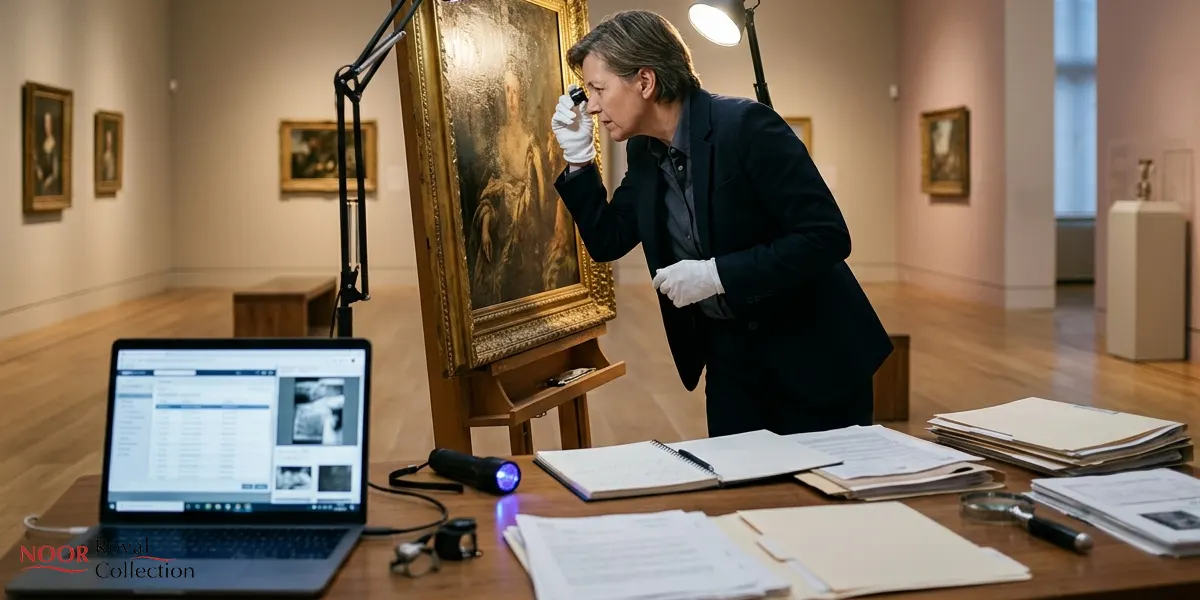

When you acquire a work of art, you are not simply buying an object; you are buying a documented claim. That claim rests on two pillars: art authentication and provenance. Together, they determine whether an artwork is genuinely what it claims to be and whether its ownership history is clear, legal, and ethically sound. Before turning to those two disciplines, it helps to see why both matter for collectors at every level, from first-time buyers entering the Dubai market to experienced collectors building a legacy.
Authentication examines whether an artwork’s attributed identity is supported by evidence. Provenance traces the artwork’s documented history through time. Used together, they help assess whether the artwork is genuinely what it claims to be and whether its ownership history is clear, legal, and ethically sound. Before any significant purchase, review credible documentation and seek independent expertise.
What Is Art Authentication?
Art authentication is the process of evaluating whether an artwork matches its represented identity. Its named artist, period of creation, medium, edition, or circumstances of production. To begin, use art historical judgment, then add scientific examination and documentary research before reaching any conclusion.
Attribution language carries significant weight. When an expert states a work is “by” a named artist, that indicates a firm attribution. “Attributed to” signals reasonable probability but less certainty. “Workshop of” or “circle of” suggests proximity to the artist without direct authorship. These distinctions directly affect cultural importance and market value. After understanding these terms, a collector paying for a firmly authenticated original should not later discover they own a work with a qualified attribution.
Authentication is rarely a binary verdict. An artwork can be genuine yet misattributed; a skilled forgery can replicate familiar surface qualities while failing on material evidence. For that reason, aim for a defensible, evidence-based conclusion, and avoid claiming certainty prematurely.
Understanding Art Provenance
Art provenance is the documented history of an artwork’s ownership, movement, exhibitions, and sales. In practice, a well-documented provenance connects a work from its creation through successive collections, gallery sales, and auction records to its current owner. Each verified link reinforces the artwork’s identity and legal standing. If a link is missing, identify the gap and gather the next available record.
Provenance is not a substitute for authentication, however. A convincing ownership story can be fabricated, and a genuine artwork can have incomplete records because private transactions were never formally documented, estates were dispersed, or historical archives were lost. The critical distinction is between a documented fact, a plausible interpretation, and an unsupported claim. When records are incomplete, verify each available source before relying on the narrative.
Provenance also carries an ethical dimension. Gaps in an artwork’s timeline, particularly during wartime or periods of forced displacement, may indicate looting, unlawful transfer, or cultural property issues. Rather than accepting “private collection” as a complete ownership record, responsible collectors investigate those gaps.
How Art Authentication Works
Stylistic and Art Historical Analysis
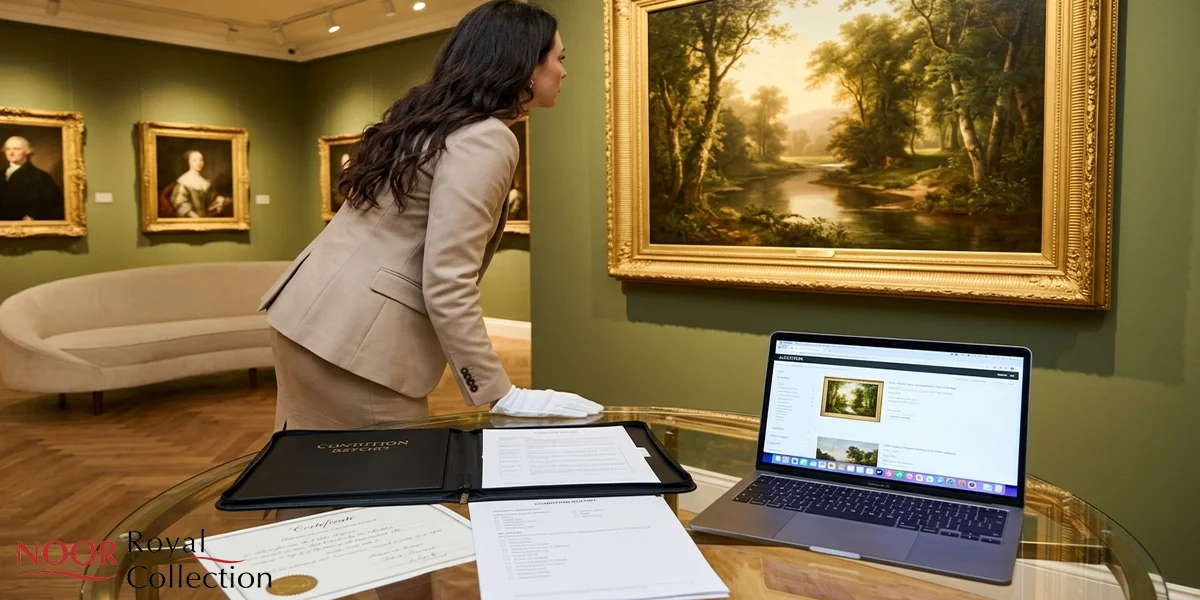
Stylistic analysis is typically the first step. Compare composition, drawing technique, brushwork, palette, and subject matter against securely documented works. Then consult catalogs raisonnés, archival records, exhibition histories, and artist correspondence to assess whether the work is consistent with what is known about an artist’s practice.
This approach requires specific expertise, not a general appreciation of art. Artists evolve, experiment, and sometimes produce atypical work. Because a knowledgeable forger can reproduce recognizable visual qualities effectively, stylistic analysis should be conducted by a specialist with genuine knowledge of the artist, period, and medium — and should form part of a broader assessment rather than standing alone.
Scientific and Technical Examination
Scientific methods examine what the naked eye cannot detect. Ultraviolet illumination reveals restored areas; infrared reflectography shows underdrawings; X-radiography exposes structural layers and hidden compositions; pigment analysis can confirm or challenge a proposed creation date. Identifying a pigment that was not commercially available until after the supposed creation date is a significant finding.
Scientific results must be interpreted carefully. If pigments were introduced during later restoration, recycled historical canvases, or unusual materials are present, they can complicate a straightforward reading. For that reason, combine technical findings with art historical judgment and documentary research, rather than treating them as standalone proof of authorship.
How to Research Artwork Provenance
Effective provenance research begins with a chronological timeline. Ask the seller for invoices, previous auction catalogs, gallery records, estate inventories, export documents, and any prior expert opinions. Then verify each record independently by confirming it refers to the specific object, matches the described dimensions, and aligns with the stated ownership dates. If any record cannot be verified, set it aside and continue with the next source.
Useful research resources include the Getty Provenance Index, which provides access to historical sales records and dealer inventories, as well as digitized auction house catalogs and museum collection databases. Search under multiple spellings of an artist’s name, former titles, and historical collection names. Remember that a missing result does not prove an artwork has no history; it may mean the relevant records have not yet been indexed.
Pay particular attention to gaps coinciding with wartime displacement or colonial acquisition periods. Document the last confirmed ownership record and the first subsequent evidence, rather than relying on a seamlessly constructed narrative that cannot be independently verified.
Warning Signs of Art Fraud
Understanding artwork authenticity also means knowing what fraud looks like in practice. Warning signs include:
- Overconfident paperwork: If a seller insists a signature or certificate resolves every question, request independent review of the artwork and its documentation before proceeding.
- Incomplete or vague provenance: Ask for names, dates, and supporting documents when a seller refers to a “private European collection.” If those details are unavailable, treat the claim as unverified and request further evidence.
- Unverifiable certificates: Confirm the certificate with the stated issuer, and compare its description with the physical object. If the issuer cannot verify it, do not rely on the certificate alone and seek another source of support.
- Artificial urgency: Pause the transaction until an independent inspection can be completed.
- Unexplained pricing: Request a clear explanation for any price significantly below comparable sales before proceeding.
No single factor proves fraud. If several appear together, increase scrutiny, request further verification, and consider declining the purchase.
Certificates of Authenticity: Value and Limitations
A certificate of authenticity is only as reliable as its source. Certificates issued by recognized specialist organizations, artist estates with authentication programs, or qualified experts with specific knowledge of the relevant artist carry genuine evidential weight. By contrast, certificates produced by sellers or individuals whose credentials cannot be verified independently carry considerably less.
Before relying on any certificate, verify the issuer’s credentials independently, confirm that the document refers to the specific object in your hands, and establish that the issuer stands behind its conclusions today. For important purchases, make certificate verification one step in a broader investigation, then continue with the remaining checks.
Legal and Ethical Responsibilities
A genuine artwork can still present serious legal complications. Possession and legal title are not automatically the same thing. An artwork may be subject to competing inheritance claims, unresolved restitution cases, cultural property restrictions, prior theft, or contested export status. In international acquisitions, compliance with both export and import requirements is essential.
Collectors should research potential restitution issues, particularly for works with gaps during the Nazi era or colonial periods, using available theft databases and specialist legal advice. For any substantial purchase, ask independent legal counsel to review the sales contract, assess representations about authenticity and title, and establish appropriate remedies if material claims prove false.
Building Your Collection’s Documentation File
Every artwork deserves a dedicated documentation file. At a minimum, this should include:
- Artist, title, date, medium, and dimensions
- High-quality photographs of the front, back, frame, signatures, labels, and any distinguishing marks
- Invoices, auction records, and ownership transfer documents
- Condition reports and restoration history
- Certificates and expert opinions, including any qualifications or limitations noted
- Insurance records and appraisals
Record each ownership link with the evidence that supports it, and clearly flag unverified claims. Secure digital backups, organized under a unique reference number for each work, help keep records accessible across ownership changes. After conservation work, relocation, or any significant new scholarly finding, review each file and update it when new evidence appears.
Due Diligence Checklist Before Buying Art
Before committing to a purchase, confirm:
- Confirm that attribution, date, edition status, and medium are described clearly and in writing.
- Confirm next steps for the available ownership, sale, and exhibition records, which have been supplied and independently verified.
- Confirm that a physical inspection by a qualified professional has been completed.
- Confirm that any certificate of authenticity has been verified directly with the issuing organization.
- Confirm next steps for documenting condition and restoration history.
- Potential theft, restitution, and export issues have been investigated.
- The seller’s legal authority to transfer title has been established.
- The purchase agreement accurately reflects all representations about the work.
- Total acquisition costs, including shipping, insurance, storage, and specialist fees, have been calculated.
The depth of this process should match the artwork’s value and complexity. A contemporary print sold directly by its artist needs a simpler process than a disputed Old Master with a complex ownership history. Proportionality is the appropriate standard.
Conclusion
Art authentication and provenance are not bureaucratic obstacles between a collector and a beautiful object. They are the framework that makes responsible, confident collecting possible. Authentication establishes whether an artwork is what it claims to be; provenance documents its history, legal standing, and ethical integrity. Together, they protect the financial value and cultural significance of everything you acquire.
The most effective approach combines careful physical examination, credible documentation, independent expert advice, and sound legal due diligence. Define exactly what is being offered, verify the supporting evidence, investigate inconsistencies, and engage specialist help when the circumstances call for it. Keep your records organized after the purchase, because documentation becomes increasingly valuable as a collection passes through generations or returns to the market.
At Noor Royal Collection, every work we represent is accompanied by transparent provenance documentation and expert authentication support. To learn more about how we approach these standards, explore our Museum or speak directly with our team.