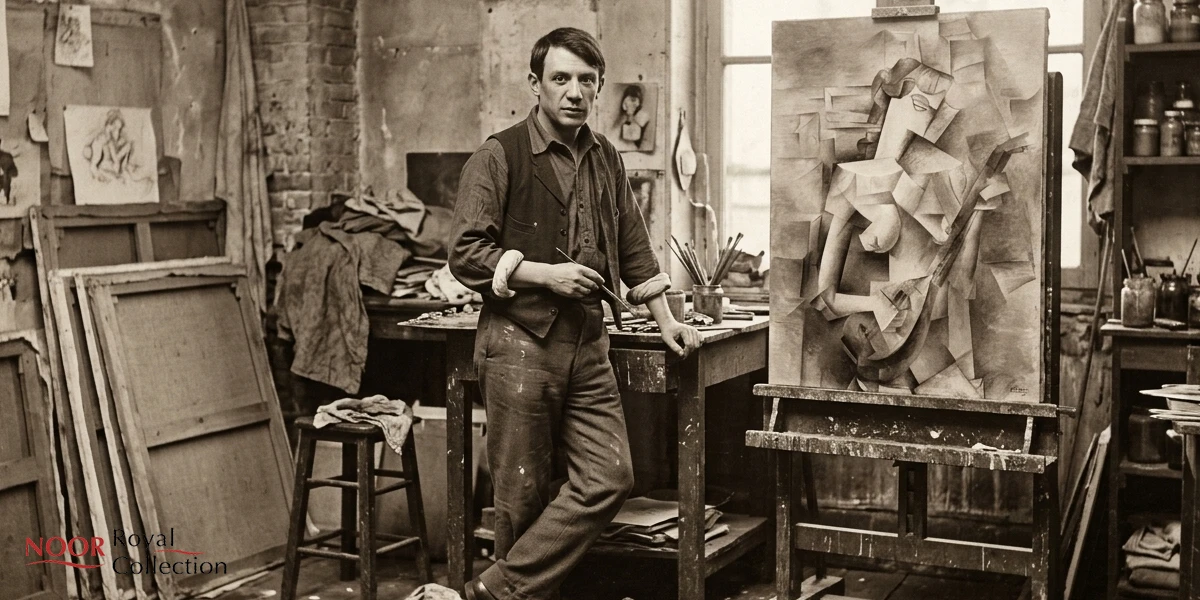
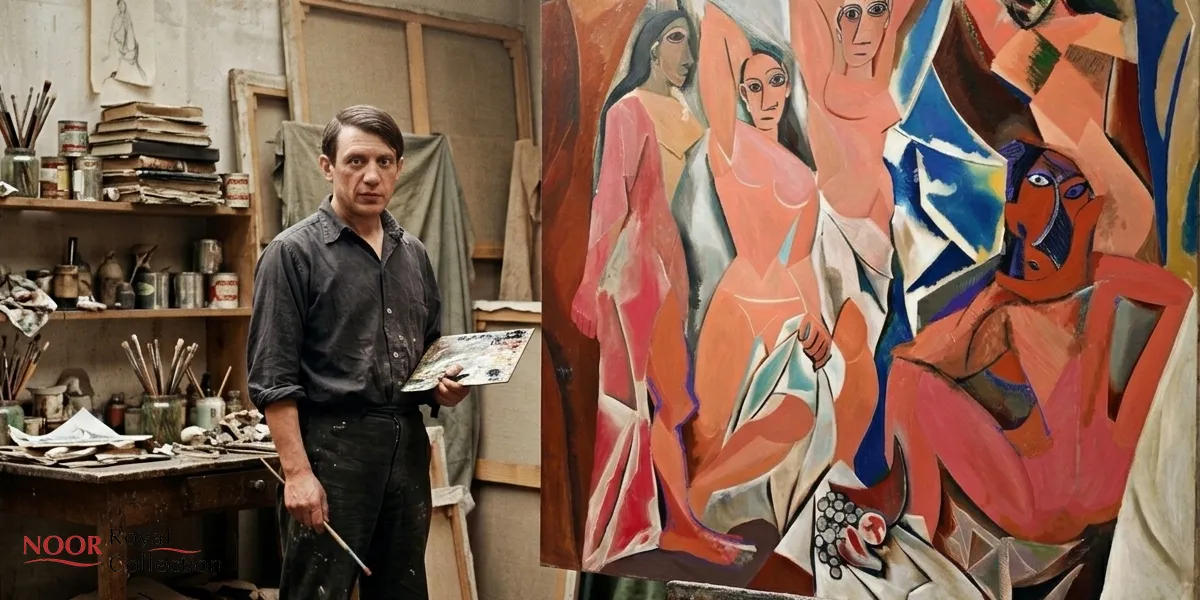
Picasso’s Cubism was an art style that helped shape what many other artists used when painting. He used shapes and different angles to create his pieces. Picasso and another French artist, Georges Braque, came up with this technique at the beginning of the 20th Century. By breaking down common objects into different shapes, they were able to portray different angles in one piece. Cubism has had a huge impact on the world of art, and people still use this idea when painting.
If you’re learning about Picasso for the first time or want to learn more about what went into his greatest works, learning about Cubism is a great way to go about it. In this artist guide, we will cover Pablo Picasso’s work and the techniques he used.
Who Was Pablo Picasso?
Picasso was born in Malaga, Spain, on October 25th 1881. He has been an influential artist throughout his career. This includes his paintings, sculptures, drawings, prints, ceramics, and even his collages. Picasso went through many periods during his lifetime. In each period, he experimented with new concepts.
Prior to Cubism, Picasso had his Blue and Rose periods. This depicted his use of color to portray certain emotions. Picasso continued to play with these themes until the end of the 1900’s. When he decided to challenge what artists were portraying in their work, he then came up with one of his greatest works, Cubism.
Throughout his life, Picasso never just followed the rules. He would try new things and challenge what other cultures portrayed in their artwork. He always looked at things differently, which allowed him to create great pieces of work.
Cubism Explained: What Made It Revolutionary?
Cubism is an early twentieth-century art movement that represents subjects through simplified geometric shapes, fragmented forms, and overlapping perspectives. Instead of reproducing an object from one fixed viewpoint, Cubist artists explored how different angles and visual impressions could coexist within the same artwork.
Imagine looking at a guitar from the front, side, and above. A traditional painting might show one view, while a Cubist composition could combine several recognizable features into a single image. The result may initially appear abstract, but closer observation reveals relationships between the shapes, lines, and objects.
Picasso and Georges Braque developed Cubism through close artistic collaboration, drawing inspiration in part from Paul Cézanne’s structural approach to painting. Picasso’s Les Demoiselles d’Avignon (1907) is widely considered a crucial precursor to the movement because its angular figures and unconventional treatment of space challenged traditional European painting.
Cubism was revolutionary because it changed the purpose of representation. Rather than treating a painting as a realistic window onto the world, artists could use the canvas to investigate perception, memory, structure, and the relationship between objects and their surroundings.
Picasso’s Main Cubist Techniques
Understanding Picasso techniques makes his Cubist paintings easier to appreciate. His approach combined careful observation with radical experimentation, allowing recognizable subjects to emerge from fragmented shapes and carefully organized compositions.
1- Geometric Simplification
Picasso reduced complex subjects to basic geometric forms, including angular planes, curved shapes, and intersecting lines. Instead of emphasizing realistic details, he focused on the underlying structure of a person, instrument, or still-life arrangement. This technique helped him create visually complex images while maintaining a sense of compositional unity.
2- Multiple Perspectives
Traditional perspective usually establishes one viewpoint. Picasso challenged this convention by combining different angles within a single composition. Facial features, for example, might appear as though seen from different directions, encouraging viewers to reconsider how a subject can be represented.
3- Fragmentation and Shallow Space
Picasso often divided subjects into overlapping sections that blended with the surrounding background. This fragmentation reduced the illusion of deep space and emphasized the flat surface of the canvas. Rather than separating every object clearly, he created relationships between forms that viewers could gradually interpret.
4- Restricted Color Palettes
During Analytic Cubism, Picasso frequently used muted browns, grays, and ochres. These restrained colors directed attention toward shape, structure, and spatial relationships rather than decorative effects. His later experiments introduced more varied colors and materials, demonstrating the flexibility of Cubist expression.
5- Collage and Mixed Media
Picasso helped expand the possibilities of painting by incorporating everyday materials into his compositions. Newspaper, printed paper, and other textures could become part of the artwork itself. This approach challenged the distinction between an object and its representation, opening new possibilities for collage and mixed-media art.
Analytic Cubism vs. Synthetic Cubism
Picasso’s Cubist work developed through two major phases. Although both challenged traditional representation, each approached form and composition differently.
|
Feature |
Analytic Cubism |
Synthetic Cubism |
|
Main period |
Approximately 1909–1912 | Began around 1912 |
|
Approach |
Breaks objects into fragments |
Builds images from simpler forms |
|
Color |
Often muted and restrained | Frequently brighter and more varied |
|
Materials |
Primarily paint and drawing |
Paint, collage, and printed materials |
| Visual effect | Complex, densely structured |
More decorative and assembled |
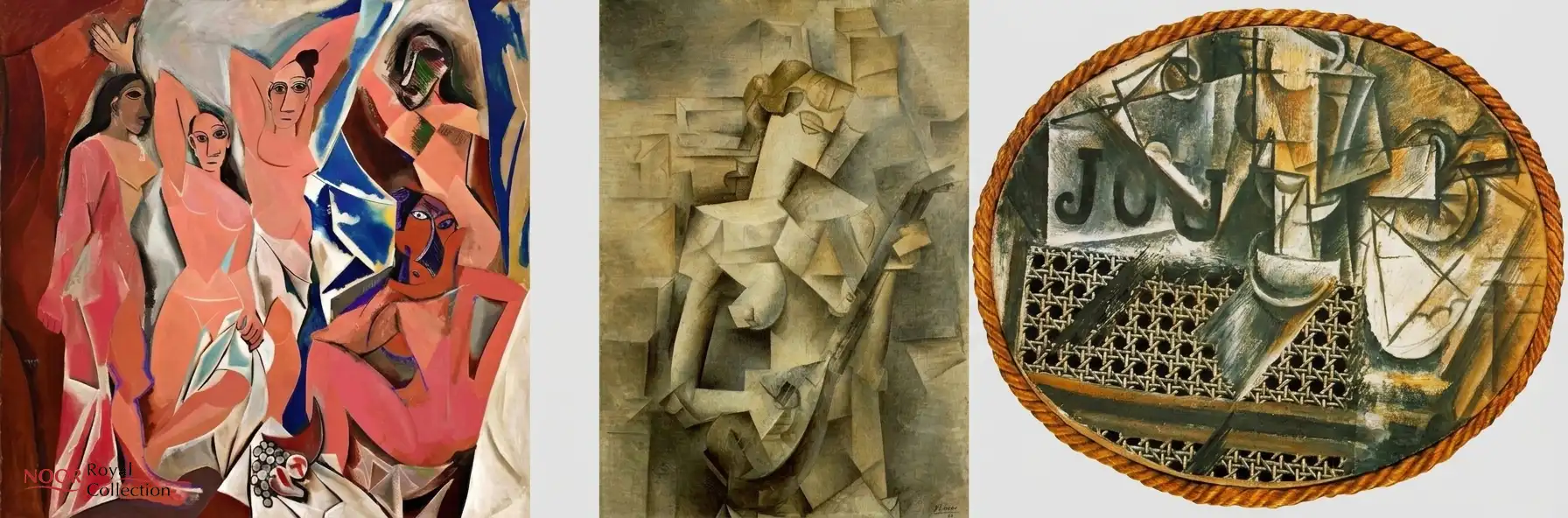
Analytic Cubism examined objects by breaking them into interconnected geometric planes. Subjects could become difficult to identify immediately, encouraging viewers to study the relationships between shapes. Picasso’s Girl with a Mandolin (1910) illustrates this approach through its fragmented figure and restrained palette.
Synthetic Cubism took a different direction. Picasso and Braque began combining simpler forms with materials such as newspaper and wallpaper, creating images through construction rather than fragmentation alone. Picasso’s Still Life with Chair Caning (1912) is a landmark example, incorporating printed oilcloth and rope into its composition.
Together, these approaches show that Cubism was not a rigid formula. It was an evolving investigation into how artists could represent, construct, and reinterpret visual reality.
Famous Picasso Cubist Artworks
Several important works demonstrate how Picasso transformed his artistic ideas into groundbreaking compositions.
Les Demoiselles d’Avignon (1907)
This influential painting depicts five female figures through angular bodies, distorted facial features, and unconventional spatial arrangements. Its departure from traditional representation helped prepare the ground for Cubism. The painting remains essential to understanding Picasso’s transition toward a more radical visual language.
Girl with a Mandolin (1910)
It shows many of the characteristics of analytic cubism. By breaking down shapes and having multiple layers, this picture allows the viewer to piece together what they are looking at without using lines to depict the person and instrument.
Still Life with Chair Caning (1912)
One of Picasso’s most significant collage experiments, this work combines painted elements with printed oilcloth and a rope frame. By incorporating a material that imitates a familiar object, Picasso challenged the distinction between artistic representation and physical reality.
These artworks reveal different stages of Picasso’s experimentation, from the disruption of conventional perspective to the creative possibilities of collage.
How Picasso Cubism Changed Modern Art
Cubism helped establish a new direction for artists who wanted to move beyond realistic representation. Its influence extended into painting, sculpture, graphic design, collage, and other forms of visual communication.
Artists could simplify objects, combine viewpoints, experiment with abstract geometry, and incorporate unexpected materials without needing to reproduce the world exactly as it appeared. These ideas helped shape the development of movements such as Futurism, Constructivism, and aspects of Dada, although each movement developed its own objectives and artistic principles.
Cubist ideas also influenced sculpture by encouraging artists to explore geometric volumes, intersecting planes, and the relationship between solid forms and empty space. In graphic design, simplified shapes and fragmented compositions demonstrated how visual communication could remain powerful without relying on realistic imagery.
Picasso’s broader legacy lies in his commitment to reinvention. Although he explored many artistic styles after his Cubist period, his early experiments helped establish creative freedom as a defining feature of modern art.
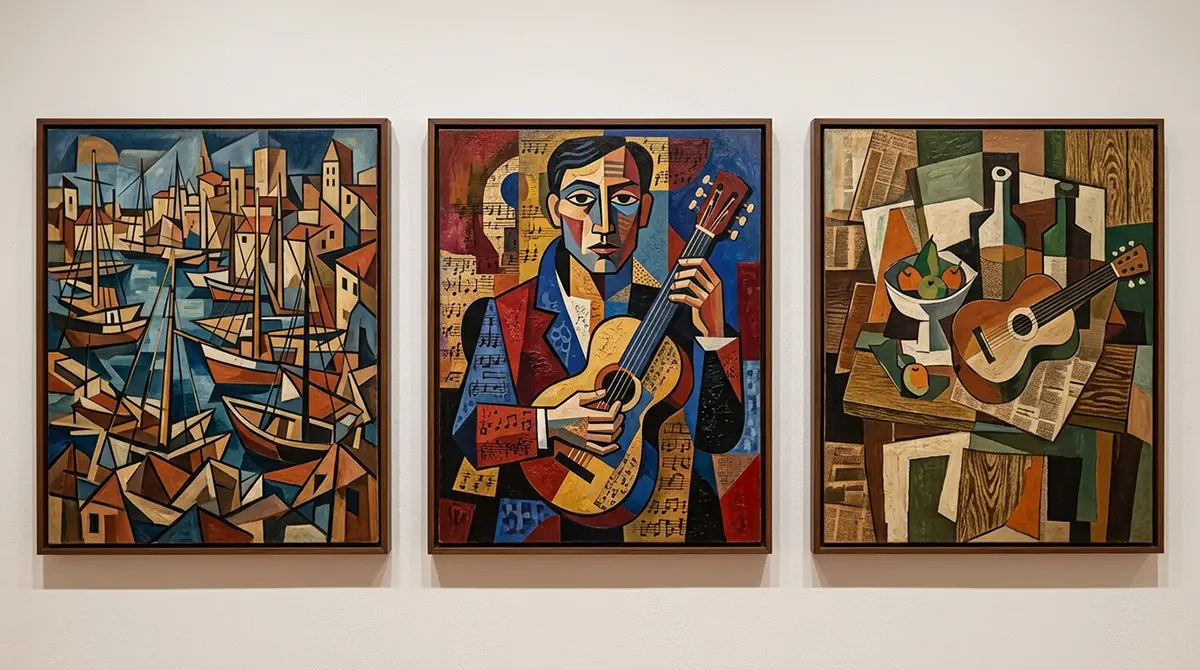
How to Appreciate Picasso’s Art Today
You do not need a formal art education to understand Picasso. Start by looking at the composition as a whole, then examine how individual shapes relate to the subject. Ask yourself which features remain recognizable and which have been transformed.
Pay attention to the relationship between the foreground and background. In a Cubist painting, these areas may overlap rather than occupy separate layers of space. Notice how lines guide your attention, how colors organize the composition, and how fragmented forms combine to suggest a familiar object.
It is also helpful to compare works from different periods. Picasso’s Blue Period paintings, Cubist compositions, and later experiments reveal an artist who continually reconsidered his methods. Looking at these changes together makes it easier to appreciate Cubism as part of a much broader creative journey.
To continue exploring his work, visit the Pablo Picasso artist page at Noor Royal Collection, where you can discover Picasso-related artwork and learn more about his artistic legacy.
Conclusion
Pablo Picasso Cubism changed modern art by challenging traditional perspective, transforming recognizable objects into geometric compositions, and expanding the materials artists could use. Through Analytic Cubism, Synthetic Cubism, and groundbreaking collage experiments, Picasso and Georges Braque established new ways to explore visual reality.
Their innovations influenced generations of artists and helped make experimentation central to modern artistic practice. Today, Picasso’s work remains an invitation to look beyond appearances, question familiar conventions, and discover new possibilities in the way we see the world.
Explore Picasso at Noor Royal Collection and discover the artwork, techniques, and ideas behind one of modern art’s most influential figures.
Frequently Asked Questions
What is Pablo Picasso best known for?
Picasso is best known for co-founding Cubism with Georges Braque and for his extraordinary range of artistic styles. His career also included influential Blue and Rose Period works, sculpture, printmaking, ceramics, and collage.
What are the main characteristics of Picasso’s Cubism?
Key characteristics include geometric simplification, fragmented forms, overlapping perspectives, shallow space, and carefully structured compositions. Some works also incorporate collage and printed materials.
What is the difference between Analytic and Synthetic Cubism?
Analytic Cubism breaks subjects into complex geometric fragments, often using muted colors. Synthetic Cubism builds images from simpler forms and frequently incorporates brighter colors and materials such as newspaper or wallpaper.
Why is Les Demoiselles d’Avignon important?
Completed in 1907, the painting challenged conventional approaches to the human figure and pictorial space. It is widely considered a pivotal precursor to Cubism.